Dialogue
We plan to support natural communication in both directions: speech ↔ symbols.

Research and development project
We are developing intelligent support for augmentative and alternative communication (AAC).
Speech and symbols, adapted to individual needs.
About the project
The project aims to combine translation between speech and symbols with personalization that takes conversational context into account.
We plan to support natural communication in both directions: speech ↔ symbols.
We aim to adapt symbols to individual needs and conversational context.
We are designing an intuitive, friendly solution for everyday use.
Project target groups
The project is intended for nonspeaking people or people with severe speech impairments who need support with everyday communication.
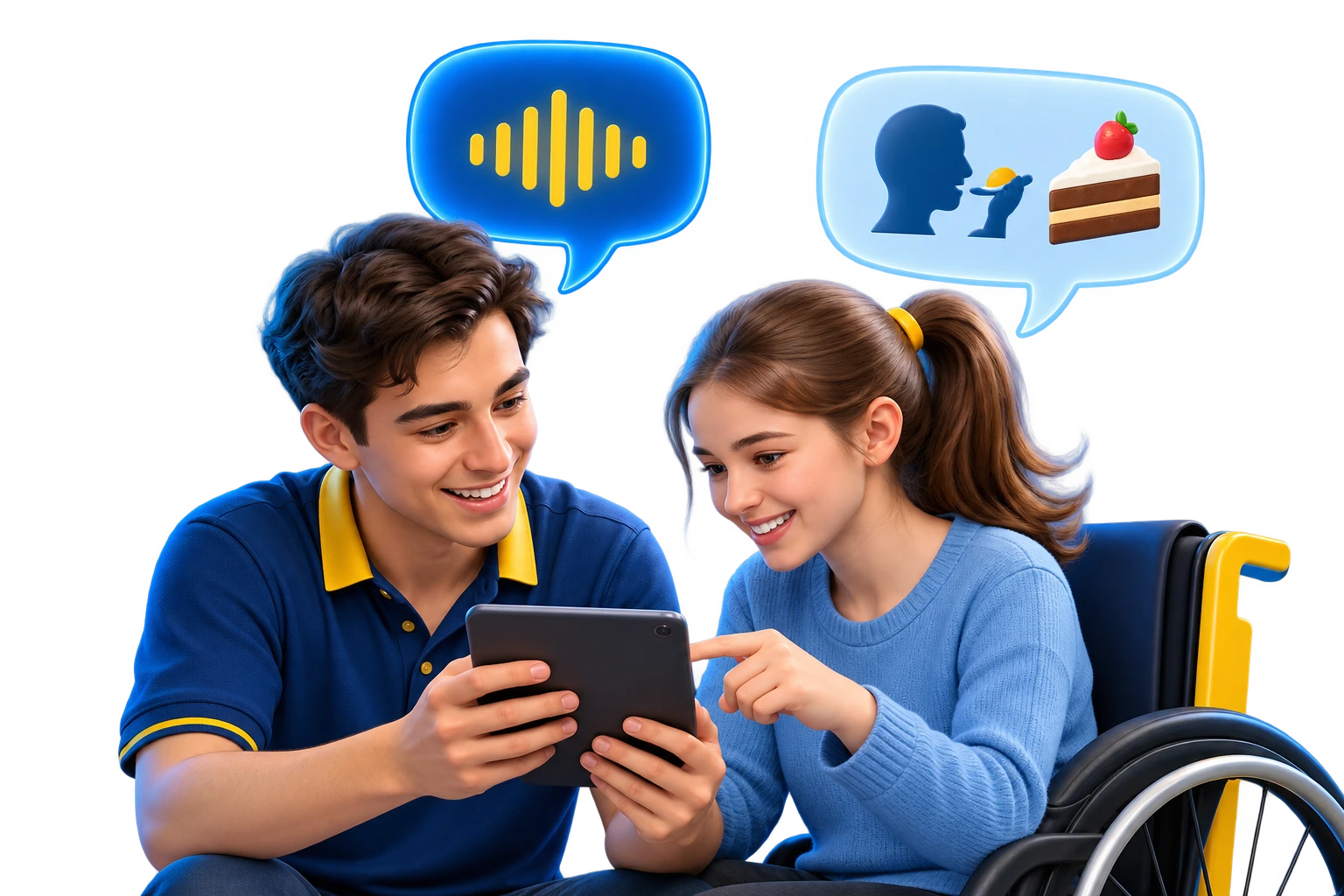
The project’s indirect beneficiaries will include families and carers who support users’ everyday communication, speech and language therapists, AAC therapists, and educational and rehabilitation institutions.
Project goal
To develop a modern, intelligent augmentative and alternative communication (AAC) system that aims to help people with speech impairments participate more fully in social life, education and work.
Increasing access to modern augmentative and alternative communication technologies.
Developing speech-to-pictogram translation adapted to the individual user.
Improving communication effectiveness in everyday situations and therapy.
Developing innovative AI-based tools adapted to users’ needs.
Planned activities
The project envisages research, development and implementation work. Planned activities cover five areas:
Developing the architecture of a communication system using artificial intelligence and machine learning. Creating models for automatic speech recognition (ASR), text-to-speech synthesis (TTS) and natural language processing (NLP).
Developing two-way translation modules: speech → pictograms and pictograms → text/speech. Integrating the system with graphic symbol libraries used in AAC, including PCS and ARASAAC.
Building and launching a prototype of the tool in a therapeutic setting. Conducting functional and validation tests with end users and specialists: speech and language therapists, AAC therapists and teachers.
Optimizing the system for performance, data security and scalability. Preparing training materials and implementation documentation.
Carrying out pilot implementations in educational, rehabilitation and care institutions.
Project support
Project value
5 254 406,77 PLNEuropean Funds contribution
3 918 779,25 PLNThe funding supports development of an AI-based communication tool.
#FunduszeUEUpdates
Week 01 / 2026
We are working on the foundations of dialogue in both directions: speech and symbols.
Week 01 / 2026
We are analyzing symbol personalization with conversational context in mind.
Questions
The project envisages translating speech into symbols and symbols into speech to support conversations between people with different communication needs.
We plan to consider individual needs and conversational context. Personalization mechanisms are part of the research and development work.
Nonspeaking people or people with significant communication difficulties, and the families, carers and specialists supporting them.
This is a research and development project. Development, testing and pilot work are planned activities, rather than confirmed outcomes or therapeutic promises.